

An Apostille is an official authentication that certifies the authenticity of the signature/seal and the capacity of the person or authority issuing a public document. It essentially functions like a “passport” for documents issued by a public authority of one country, as it allows them to “travel” abroad without the need for additional legalisation or certification. This process was established through the 1961 Hague Convention, which simplified the authentication of public documents among the countries that are signatories to the convention.
We have prepared a comprehensive guide that will help answer any questions you may have about the Apostille certification: which documents require an Apostille, what the process entails, how an Apostille is translated, how to obtain an Apostille in Cyprus, and additional information on documents that are either exempt from Apostille certification or originate from countries that are not part of the Hague Convention.
If you prefer, you can also read this Article in Greek.
Which Documents Require an Apostille?
The Hague Apostille is necessary for various public documents intended for administrative use in another country. Some of these include:
- Civil Registry Documents: Birth, marriage, divorce, and death certificates.
- Academic Documents: Diplomas, transcripts, enrollment certificates, and graduation certificates.
- Legal Documents: Court decisions.
- Commercial Documents: Certificates of incorporation, certificates issued by the Registrar of Companies.
- Police Clearance Certificates: Criminal record certificates and other legal documents.
It is important to note that if a public authority in Cyprus requires an Apostille certification on a document originating from abroad, you must contact the embassy or consulate of the document’s country of origin in Cyprus, or arrange for your document to be “apostilled” before your arrival to Cyprus. Documents receive Apostille certification in the country where they were issued to be officially recognised abroad. Cypriot public authorities cannot affix an Apostille to documents issued outside Cyprus.
When Does My Document Require an Apostille?
The need for an Apostille depends on the country where the document will be used. Within the European Union, Regulation (EU) 2016/1191 has significantly reduced the need for Apostille certification, as it allows direct recognition of documents among member states without additional authentication. However, for documents originating from or intended for use outside the EU, Apostille certification is required.
Before using a document internationally, it is essential to contact the relevant authority in the destination country to confirm their specific requirements. Below, you will find a list of countries that are parties to the Hague Convention on Apostille certification and therefore accept documents bearing the Hague Apostille.
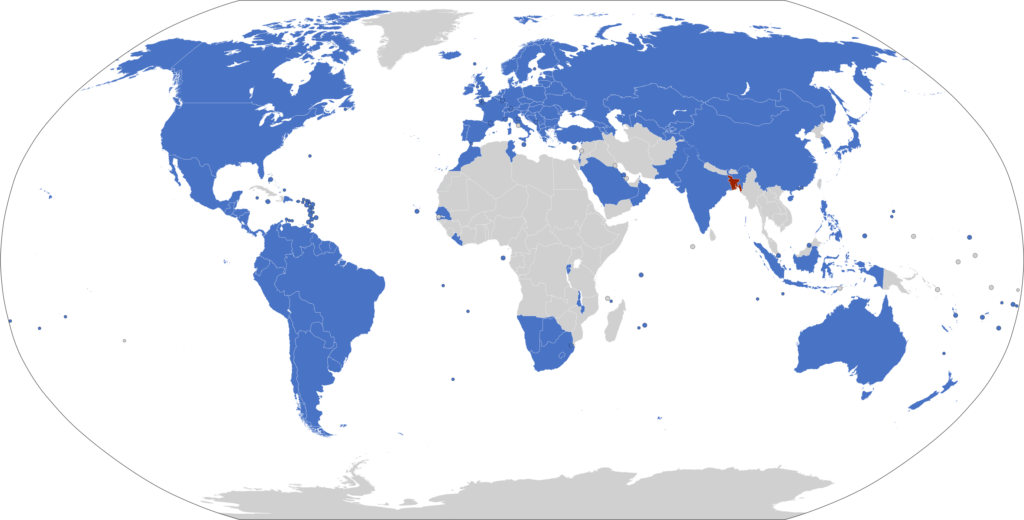
By BlankMap-World_gray.svg: Original by User:Vardion, svg-ified by Simon Eugster —Simon 23:14, 1 August 2006 (UTC)derivative work: Nauka (talk), Heitordp – Own work based on: World map configurable.svg, CC BY-SA 3.0, Link
English-Speaking Countries Participating in the Hague Apostille Convention:
- Antigua and Barbuda
- Australia
- Bahamas
- Barbados
- Belize
- Botswana
- Canada
- Dominica
- Grenada
- Ireland
- Jamaica
- Lesotho
- Malawi
- Malta
- Marshall Islands
- Mauritius
- Namibia
- New Zealand
- Saint Kitts and Nevis
- Saint Lucia
- Saint Vincent and the Grenadines
- Samoa
- Seychelles
- South Africa
- Trinidad and Tobago
- United Kingdom
- United States of America
French-Speaking Countries Participating in the Hague Apostille Convention:
- Andorra
- Belgium
- Canada
- France
- Luxembourg
- Mauritius
- Monaco
- Senegal
- Seychelles
- Switzerland
German-Speaking Countries Participating in the Hague Apostille Convention:
- Austria
- Belgium
- Germany
- Liechtenstein
- Luxembourg
- Switzerland
Greek-Speaking Countries Participating in the Hague Apostille Convention:
- Cyprus
- Greece
Countries Not Participating in the Hague Apostille Convention:
- Algeria
- Benin
- Burkina Faso
- Cameroon
- Central African Republic
- Chad
- Comoros
- Democratic Republic of the Congo
- Djibouti
- Equatorial Guinea
- Gabon
- Ghana
- Guinea
- Haiti
- Ivory Coast
- Lebanon
- Madagascar
- Mali
- Morocco
- Niger
- Nigeria
- Republic of the Congo
- Rwanda
- Sao Tome and Principe
- Togo
- Vanuatu
- Zambia
- Zimbabwe
Not all countries are represented in the lists above. For our customers’ convenience, the lists include only countries with English, Greek, French and German as their official languages. You can find a full list of the countries participating in the Hague Convention here.
EU Regulation for public documents
Since February 16, 2019, certain public documents and certified copies have been exempt from legalisation and Apostille certification within the European Union. Specific documents may use a multilingual standard form instead of requiring a translation. Certified translations from any EU member state are accepted.
Documents Covered:
- Judicial, administrative, and notarial documents
- Official certificates on private documents
- Diplomatic and consular documents
Multilingual Standard Forms Available for:
- Birth, death, and life certificates
- Name, nationality, and residence
- Marriage, capacity to marry, and marital status
- Divorce, legal separation, and annulment
- Registered partnerships, dissolution, and status
- Parental status and adoption
- Criminal record extracts
- Voting rights in European/local elections
If an EU member state accepts certified copies, it must recognize copies issued by the country of origin.
Exemptions from Apostille Certification: Certain documents are also exempt based on international agreements or bilateral treaties, such as those exchanged between public authorities relating to social security, pensions, taxation, education, professional qualifications, and medical certificates.
Can You Provide a Translation with an Apostille?
Metafrastis.com.cy is not a public authority and therefore cannot affix an Apostille on any documents. The Apostille is issued only by the competent administrative authority in the country of origin of the document. Once the Apostille process is completed, the document and the Apostille certification can be translated as needed. The Apostille itself is translated by the sworn translator into the target language. However, an additional Apostille cannot be affixed to the translation, nor can an Apostille be issued for a document that has already been translated.
Examples of Competent Authorities for Apostille Issuance:
Australia: Australian Passport Offices in Capital Cities
Cyprus: Apostille Offices in Limassol and Nicosia, and Citizen Service Centers (KEP-KEPO)
France: Local Courts of Appeal (Cour d’Appel) – Depending on the document type
Belgium: Electronic Document Certification
Austria: Available in electronic format
Switzerland: Regional Courts – Depending on document type
United Kingdom: Foreign, Commonwealth & Development Office (FCDO) – E-Apostille
United States: USA Authorized Authorities
Canada: Global Affairs Canada
If you are in Cyprus and possess an official document from a foreign country that does not bear an Apostille, it is recommended to contact the embassy or consulate of the document’s country of origin to arrange for the issuance of the Apostille certification.
What is the process of obtaining an Apostille in Cyprus?
The process involves the following steps:
- Document Verification – The document must have been issued in Cyprus.
- Submission to the Competent Authority – The original document is submitted to the Apostille Office in Limassol or Nicosia or to the Citizen Service Centers (KEP-KEPO).
- Apostille Issuance – The authenticity of the document’s signature/seal is verified, and the Apostille is affixed.
For more information, visit the official government website.
Private Documents and Apostille
An Apostille can also be affixed on private documents and documents of public law in Cyprus as follows:
- Certification of Signature by a Certifying Officer – A private document or a public law document bearing a signature and/or seal must first be presented to an appointed Certifying Officer, who will authenticate the signature on the original document.
- Submission to the District Administration – The document is then submitted to the District Administration Office, where the signature and capacity of the Certifying Officer is certified.
- Submission for Apostille – Once the Certifying Officer’s signature has been verified by the District Administration Office, the document is submitted for an Apostille certification of the signature of the District Administrator Officer’s signature.
- Translation – After the Apostille has been affixed to the original document, the document, the Apostille, and all seals included in the document can be translated.
Documents from Third Countries
Documents originating from third countries that are to be submitted to a public authority in Cyprus follow a similar process:
- Certification of Signature by a Certifying Officer/Notary – Depending on the country of origin, the document must first be presented before a Certifying Officer or Notary in the country of issuance to authenticate the signature.
- Submission to Local Administrative Services – The document must then be submitted to the relevant local administration office in the country of issuance, where an officer will authenticate the signature and seal of the Certifying Officer or Notary.
- Submission for Legalization – Once the Certifying Officer’s signature has been verified by the local administration, the document is then submitted for legalization, either at the Ministry of Foreign Affairs of the Republic of Cyprus in Nicosia or at a Cyprus Embassy/Consulate/High Commission in the country of origin (or a neighbouring country).
- Translation – After the Apostille has been affixed to the original document, the document, the Apostille, and all seals included in the document can be translated.
Summary of the Process
- Issuance of the document by the competent authority.
- Obtaining the Apostille/legalization in the country of origin.
- Translation of the document and Apostille if required.
- Submission of the translated document to the relevant authority.
Translation of Apostille and Documents
Once the Apostille has been obtained, the document can be translated into the desired language. The team of metafrastis.com.cy provides certified translations by sworn translators into English, French, German, and Greek.
For officially certified translations of documents with an Apostille by sworn translators in Cyprus, trust the experts at metafrastis.com.cy.
Contact us today!